
Why Do Your Ears Feel Clogged After Flying—and When Could It Be Eustachian Tube Dysfunction?
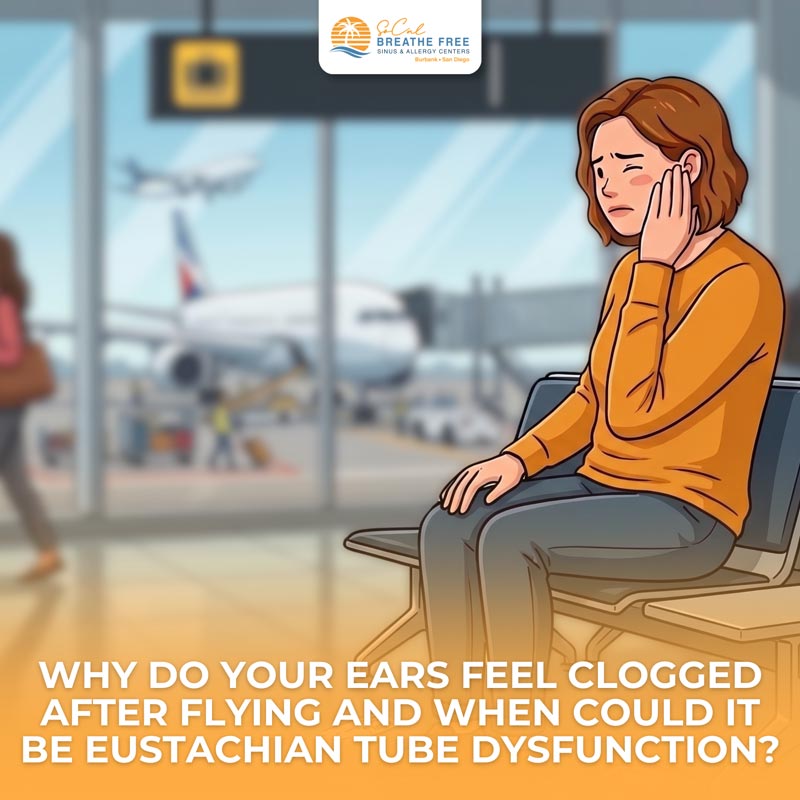
You are on a plane heading toward a long-awaited vacation when a familiar sensation returns: your ears begin to feel plugged, full, or difficult to pop during takeoff or landing.
Temporary ear fullness is common during air travel. It develops when the pressure inside the middle ear does not adjust as quickly as the air pressure inside the airplane cabin. Yawning, swallowing, or chewing gum may help the ears equalize.
In many cases, the pressure improves shortly after landing. When symptoms persist for several days, occur during nearly every flight, or become severe, Eustachian tube dysfunction may be one possible explanation.
At SoCal Breathe Free, patients in Burbank and the surrounding Los Angeles area can receive an evaluation to determine whether persistent ear pressure is associated with temporary airplane ear, Eustachian tube dysfunction, an ear infection, or another condition.
Why Do Your Ears Feel Clogged During a Flight?
The middle ear is an air-filled space located behind the eardrum. A narrow passage called the Eustachian tube connects the middle ear to the back of the nose and upper throat.
The Eustachian tube briefly opens when you swallow, yawn, or chew. This allows air to enter or leave the middle ear so that pressure remains relatively equal on both sides of the eardrum.
During takeoff and landing, cabin pressure changes more quickly than the pressure in the middle ear. If the Eustachian tube does not open quickly enough, the pressure becomes temporarily unequal and places stress on the eardrum.
This condition is commonly called airplane ear. It may also be called ear barotrauma, barotitis media, or aerotitis media.
Common symptoms include:
- Ear fullness or stuffiness
- Pressure or discomfort
- Muffled hearing
- Difficulty popping the ears
Symptoms may affect one or both ears.
Is Airplane Ear Normal?
Mild ear pressure during takeoff or landing is common and often improves with swallowing, yawning, or other pressure-equalizing movements.
However, airplane ear is not always completely harmless. A significant pressure difference can occasionally injure the eardrum or other ear structures. Severe symptoms may include:
- Intense ear pain
- More noticeable hearing loss
- Tinnitus
- Vertigo
- Bleeding or drainage from the ear
These symptoms warrant medical evaluation.
How Long Should Clogged Ears Last After Flying?
There is no single recovery timeline that applies to everyone. Mild pressure may improve during the flight or shortly after landing. In other cases, fullness or muffled hearing may continue for several hours or a few days while the pressure gradually equalizes.
The duration can depend on:
- How quickly the cabin pressure changed
- Whether the person had a cold, allergies, or congestion
- Whether an ear infection was present
- How effectively the Eustachian tubes opened
- Whether the pressure change irritated or injured the eardrum
Ear fullness that lasts longer than a few days, becomes worse, or occurs with significant pain or hearing changes should be evaluated.
What Is Eustachian Tube Dysfunction?
Eustachian tube dysfunction, or ETD, occurs when one or both Eustachian tubes do not open and close as expected.
Depending on the type and cause, ETD may interfere with pressure regulation or middle-ear ventilation. Symptoms may include:
- Persistent fullness or pressure
- Muffled hearing
- Ear discomfort
- Popping or clicking
- Difficulty equalizing the ears
- Tinnitus
- Hearing changes
- Mild dizziness or imbalance in some cases
These symptoms can occur with many ear conditions, so their presence does not confirm ETD. An examination and, when appropriate, hearing or middle-ear pressure testing can help determine the cause.
What Is Baro-Challenge Eustachian Tube Dysfunction?
Some people have few or no ear symptoms during everyday activities but experience pressure, pain, or muffled hearing during altitude changes. This pattern may be associated with baro-challenge-induced Eustachian tube dysfunction.
Symptoms may develop during:
- Airplane takeoff or landing
- Driving through mountains
- Rapid elevator rides
- Scuba diving
- Hyperbaric oxygen treatment
A person with baro-challenge ETD may have a normal ear examination when evaluated at ground level. The timing and pattern of symptoms can therefore be important parts of the diagnosis.
Is It Airplane Ear or Eustachian Tube Dysfunction?
Airplane ear and ETD are closely related, but the terms do not mean exactly the same thing.
Airplane ear describes the pressure-related stress placed on the eardrum and middle ear when cabin pressure changes more quickly than the middle ear can adjust.
Eustachian tube dysfunction describes a problem with how the Eustachian tube opens, closes, or regulates middle-ear pressure.
Airplane ear can happen to someone without chronic ETD when pressure changes rapidly. However, a person with ETD may have more difficulty equalizing pressure and may be more susceptible to discomfort during flights.
Repeated or prolonged airplane-ear symptoms may therefore prompt an evaluation for underlying ETD.
What Can Make Airplane Ear More Likely?
Anything that narrows or interferes with the Eustachian tube may increase the risk of pressure problems during a flight.
Potential risk factors include:
- The common cold
- Nasal congestion
- Allergies
- Sinusitis
- A middle-ear infection
- Smaller Eustachian tubes in infants and young children
- Sleeping during takeoff or landing
- Recent ear surgery
- A history of difficulty equalizing the ears
Sleeping during takeoff or landing can increase the risk because you may swallow or yawn less often while the cabin pressure is changing.
How Can You Help Your Ears Equalize During a Flight?
Several strategies may help reduce mild pressure during takeoff and landing.
Stay awake during takeoff and landing
Remaining awake allows you to actively swallow, yawn, or use another pressure-equalizing technique while cabin pressure changes.
Swallow frequently
Chewing gum, sipping water, or sucking on candy may encourage swallowing and help the Eustachian tubes open.
Yawn
Yawning may briefly open the Eustachian tubes and allow the middle-ear pressure to adjust.
Try a gentle Valsalva maneuver
Close your mouth, pinch your nostrils, and gently attempt to blow air through your nose. The maneuver should be gentle and should not cause pain.
Do not forcefully blow against a closed nose. Excessive pressure can injure the eardrum or inner ear.
Consider pressure-regulating earplugs
Filtered earplugs are designed to slow pressure changes reaching the eardrum. They may be helpful for some travelers, although swallowing and yawning are still needed.
Ask about medications before flying
Some travelers use nasal sprays, allergy medication, or oral decongestants before flying. These products are not appropriate for everyone and may cause side effects or interact with health conditions.
Oral decongestants may be unsuitable for people with high blood pressure, certain heart conditions, heart-rhythm disorders, or pregnancy. Topical decongestant sprays can cause rebound congestion when used longer than directed.
Ask a healthcare provider or pharmacist whether a medication is appropriate for you.
Should You Fly With a Cold or Ear Infection?
If possible, postponing air travel may be worth considering when you have significant congestion, an active sinus infection, or a middle-ear infection. These conditions may make it more difficult for the Eustachian tubes to equalize pressure.
If travel cannot be postponed, ask a healthcare provider what precautions may be appropriate based on your symptoms and health history.
People who have recently undergone ear surgery should receive specific clearance from their surgeon before flying.
How Is Persistent Ear Pressure Evaluated?
An ENT evaluation may include:
- Reviewing when the symptoms started
- Determining whether one or both ears are affected
- Asking whether symptoms occur only during flights
- Examining the ear canals and eardrums
- Looking for middle-ear fluid or infection
- Evaluating the nose and throat for inflammation
- Performing tympanometry to assess middle-ear pressure
- Ordering hearing testing when appropriate
The goal is to determine whether symptoms resulted from temporary barotrauma, obstructive ETD, middle-ear fluid, an infection, or another ear condition.
For patients with persistent obstructive ETD, treatment depends on the cause, duration, examination findings, and severity. Some appropriately selected patients may be evaluated for Eustachian tube balloon dilation, but not every case of clogged ears requires a procedure.
When Should You See a Healthcare Provider?
Consider scheduling an evaluation if:
- Ear fullness lasts longer than a few days
- Pressure or pain becomes worse after landing
- Symptoms occur during nearly every flight
- The ears remain difficult to pop
- Muffled hearing does not improve
- Ear pressure keeps returning
- Symptoms interfere with sleep, work, or daily activities
- You need to fly frequently and regularly experience significant symptoms
When Is Ear Pressure an Urgent Concern?
Seek prompt medical attention for:
- Sudden or significant hearing loss
- Severe or worsening ear pain
- Blood, pus, or clear fluid draining from the ear
- Severe vertigo
- Difficulty walking or maintaining balance
- High fever
- Symptoms following an injury
- Facial weakness or other neurological symptoms
Sudden hearing loss may feel like a blocked ear and should be treated as an urgent medical concern rather than assumed to be congestion or ETD.
Understanding Airplane Ear and ETD With SoCal Breathe Free
Clogged ears during takeoff or landing commonly develop when the Eustachian tubes cannot equalize middle-ear pressure quickly enough. Mild airplane ear often improves with swallowing, yawning, or chewing, but symptoms that persist, recur frequently, or become severe may warrant evaluation for ETD or another ear condition.
SoCal Breathe Free provides ear, nose, and throat care for patients in Burbank and the surrounding Los Angeles area.
If ear pressure or pain continues after a flight, schedule an evaluation at our Burbank location to discuss what may be contributing and which treatment options may be appropriate.
Chronic ear infections can be frustrating and painful, particularly for those who experience them frequently. While occasional ear infections are…