
Stop Sinusitis
Stop Sinusitis
Sinus problems can significantly disrupt your life. Symptoms of sinusitis, such as congestion and headaches, can affect not only physical health but also mental well-being, making daily tasks and social activities challenging. SoCal Breathe Free is here to provide relief and help you regain control of your life. Discover care options tailored to your sinus symptoms.

Stop Sinusitis Symptoms
Symptoms of sinusitis differ from those of a common cold. Often, cold symptoms improve within 3-5 days whereas sinusitis, and its multitude of ailments, persists longer than 10 days without improvement. Other symptoms include:
- Facial pain and/or pressure: Occurs around the eyes, nose, jaw and teeth
- Fatigue: Feeling tired due to lack of sleep caused by pain and congestion
- Low grade fever
- Frequent stuffy nose and congestion: Swollen nasal passages make breathing difficult and lead to a stuffy nose
- Blocked nasal passageways
- Decreased sense of taste and smell
- Headaches
- Postnasal drip: Mucus trickling from the back of the nose into the throat
- Nasal Discharge: Green or yellow mucus draining from the nose
It’s crucial to obtain a sinusitis diagnosis from a trusted ENT expert. At SoCal Breathe Free, our team of dedicated professionals can help you STOP sinusitis.
Stop Sinusitis and Reclaim Your Health
Sinusitis sufferers have a variety of treatment options to consider with our trusted practitioners, ranging from over-the-counter medications to surgical procedures.
- Medication: Depending on your symptoms, the severity and the duration, our physicians may recommend medications to help alleviate your symptoms. Prescription, over-the-counter, and home remedies are options.
- Decongestants to reduce swelling of the sinus lining
- Nasal and systemic steroids to reduce chronic inflammation
- Mucolytics to help thin thickened nasal secretions
- Sinus irrigation to cleanse the sinuses
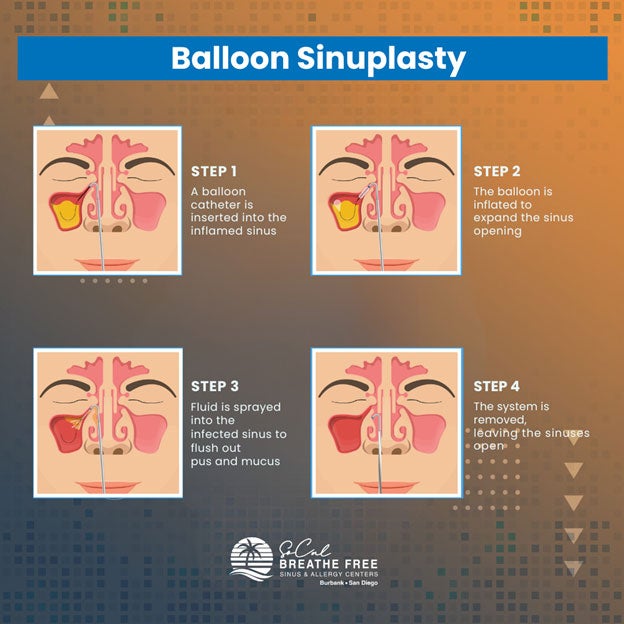
- Balloon Sinuplasty: Balloon sinuplasty, or balloon sinus dilation, is a minimally invasive procedure that gently enlarges your natural sinus openings in order to improve your drainage issues and correct your nasal anatomy. It is a patient-friendly alternative to surgery.
- Conveniently, balloon sinuplasty is performed in the comfort of our office and takes about an hour.
- Explore whether balloon sinuplasty fits your sinus condition, with an individual discussion of benefits, risks, and recovery.
- Sinus Surgery: Functional endoscopic sinus surgery (FESS) may be a suitable option for certain sinusitis sufferers. The goal of this procedure is to enhance your sinus drainage and overall function of your nasal anatomy by facilitating the natural flow of mucus and expanding your natural sinus openings. Balloon sinuplasty can be used in conjunction with a FESS procedure as well.

Stop Sinusitis With Socal Breathe Free
At SoCal Breathe Free Sinus and Allergy Centers, we want to help STOP your sinusitis. Schedule an appointment today with our experienced and friendly team to explore treatment options for your sinus symptoms.
FAQs About Sinusitis Relief
If you don’t find sinusitis relief with home remedies, don’t worry. The team at SoCal Breathe Free Sinus and Allergy Centers is here to help. Treatment options may include minimally invasive approaches such as balloon sinuplasty to relieve your congestion. Every patient is different, and we’ll come up with a tailored plan according to your specific needs. Over-the-counter decongestant nasal sprays can provide quick relief from a stuffy nose. Nevertheless, you should use extreme caution with nasal sprays. Most sinusitis doctors strongly advise against using these decongestant sprays for more than three to four consecutive days. If you use them longer, you risk developing a condition called rebound congestion. Your nasal passages become dependent on the medication, and the swelling could return even worse than before once the spray wears off. Some patients get sinusitis relief from easy home remedies. Staying hydrated and applying warm (but not hot) compresses to the face may help thin out the mucus and relieve pressure for some patients. However, professional evaluation is often recommended for persistent or severe symptoms. Always speak to your doctor before trying a home remedy, and know that while they may be effective in the short term, they usually aren’t permanent solutions. Most people would prefer to prevent the condition than treat it. Fortunately, you can take several steps to lessen the likelihood of getting sinusitis. Here are a few practical tips: A sinusitis diagnosis comes in many forms, classified by how long the condition lasts and what caused it. There are four main categories: Most people never need surgery to manage sinusitis. However, if your condition hasn’t responded to normal chronic sinusitis treatment, your doctor might recommend looking at your sinus surgery options. Usually, surgery is only considered when structural issues are the cause of your ongoing problem. Things like a severely deviated septum, polyps that block the airway, and abnormally narrow sinus openings can all be corrected surgically. Irritants in the environment play a significant role in sinus health. Tobacco smoke is particularly harmful to your respiratory system. Your nasal passages are lined with tiny, hair-like structures called cilia. Normally, the cilia sweep trapped particles out of your nose, but smoke damages them. When cilia don’t function properly, mucus builds up, increasing the risk of infection. Other irritants like strong cleaning fumes, industrial pollution, and heavy dust can trigger similar inflammatory responses. A sinus infection typically begins with a blockage in the nasal passages. Most commonly, a viral infection, such as the common cold, causes the initial swelling. When the sinus openings are blocked by this swelling, the mucus can no longer drain properly. Now that the mucus is stuck with nowhere to go, it may create conditions where bacteria can grow in some cases. In addition to viral infections, other common causes of nasal blockages include allergies, nasal polyps, and a deviated septum.